
How to Get Court Records
Pull the docket first. Its case number, court, filing date, and document names let a clerk pull one real file instead of guessing. Somervell splits its holdings by court and case type. District civil, criminal, family, juvenile, grand-jury, and minor-trust files go to the Somervell County District Clerk, while county civil, probate, guardianship, misdemeanor, juvenile, and County Court files go to the Somervell County Clerk. A JP or Glen Rose case stays with that lower court.
Two portals cover online docket search. Tyler UCMS carries district events and County Court criminal indices; re:SearchTX carries participating county civil, guardianship, and probate cases. At the County Clerk's office, visitors can search indices and images on an office computer. Missing district images can be requested at the counter, by mail, or through published email and fax contacts.
- Record the court, case number, document title, and approximate date.
- Check the correct portal and open the events view.
- Ask whether an absent image is restricted, unscanned, or held elsewhere.
- Specify plain or certified copy and confirm the charge.
- For a transcript, contact the court reporter.
Somervell Court Record Layers
Three different products get mistaken for one another. The docket is just the dated index of filings, settings, and rulings. Behind each entry sits a filed document, whether a petition, motion, order, judgment, return, or exhibit. A certified copy adds the clerk's authentication. A portal printout is not a certified copy.
| Record | What It Supplies | Best Route |
|---|---|---|
| Docket sheet | Chronology, settings, status | Tyler, re:SearchTX, or clerk |
| Filed document | Text and image of a filing | Portal, terminal, or request |
| Certified copy | Authenticated reproduction | Custodial clerk |
Want the final result? Ask for the signed judgment or order, not just a line marked disposed. A docket shows that something happened, but it may leave out the court's full terms.
Types of Court Records
Somervell County court records live in more than one office. District files can hold petitions, answers, motions, and notices. Orders, judgments, exhibits, service returns, and docket sheets may appear as well. County Clerk files handle probate estates and guardianships. County civil suits, misdemeanor criminal matters, and related orders sit there too. Justice courts keep Class C citations, evictions, small claims, and justice civil claims. Glen Rose Municipal Court holds the city's traffic and ordinance cases.
Two items come from somewhere else. A reporter's transcript records spoken proceedings in writing. You must order it from the reporter who made it. Administrative county material may go through the open-records channel. A judicial case file, though, normally goes straight to its clerk.
Somervell Court Records at Terminals
The Official Public Records page invites the public to review indices and images on office computers. The County Clerk also welcomes in-office searches. The office does not promise a terminal count. Nor does it offer staff research. Nothing goes beyond what the web portal offers.
The official page describes the local records office and the public access it provides.
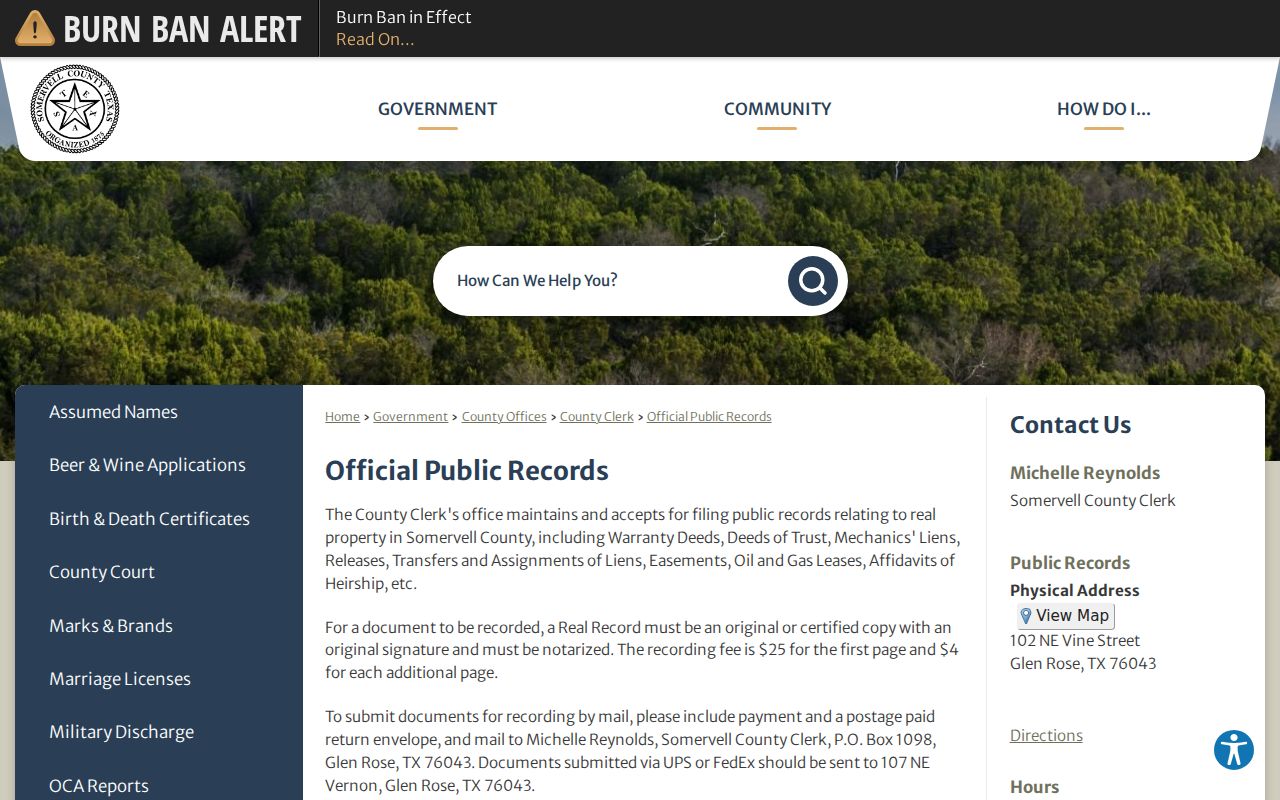
That in-person path matters most when an image is missing online. It also helps when you need staff to point you to the right index.
Somervell County Clerk
102 NE Vine Street
Glen Rose, TX 76043
254-897-4427
Monday–Thursday 7:30 a.m.–4:30 p.m.; Friday 7:30 a.m.–3:00 p.m.
Somervell County District Clerk
101 NE Barnard Street
Glen Rose, TX 76043
254-898-3971
Monday–Friday 7:30 a.m.–4:30 p.m.
The County Clerk stops taking money 30 minutes before close. One subpage lists a different Friday close, so call ahead before any fee-dependent trip.
What a Court Record Contains
A case-detail screen shows the case number and type. It can also list filing date, parties, attorneys, judicial officers, hearings, events, and document rows. Each event may list a date, type, comment, document name, page count, price, and status. Fields shift with the case and your access role. A public account does not see every image a party or attorney can.
| Case header | Number, type, court, filed date, and status. |
|---|---|
| People | Public party names, attorneys, and judicial officer. |
| Events | Dated filings, settings, rulings, and disposition activity. |
| Documents | Name, page count, price, and access status. |
| Disposition | Outcome entry; consult the signed order for full terms. |
County Court civil numbers follow a family such as YY-213-CCCV-NNNNN. Here 213 identifies Somervell, and CCCV marks county civil. Don't assume District Court files use that pattern.
Older Somervell Court Records
Scanning began in August 2005, per the County Clerk. Older records were still being back-scanned. A blank web search can mean the image hasn't reached the online layer yet. It doesn't prove the record never existed or was sealed. Ask for an index, paper file, archive, or microfilm check. That law is Texas Government Code Section 51.902. It lets district clerks preserve records through microfilm, image processing, or another legible reproduction method. When no docket number survives, help the clerk instead. Give a name variation, an approximate year, the case type, and the likely court.
Certified Copies and Fees
The District Clerk fee PDF sets a $5 search when no cause number is supplied. A criminal-name search costs $5 too. Its dense table lists paper copies at $1 per page, with an electronic schedule of $1 per page for pages one through ten, then $0.10 per page after that. Confirm certification entries before relying on them. On re:SearchTX, public documents run $0.10 per page with a $1 minimum, and purchases stay available for up to 30 days.
| Item | Published Amount |
|---|---|
| Locate cause without docket number | $5 District search |
| Criminal search by name | $5 District search |
| District paper copy | $1 per page; confirm |
| re:SearchTX document | $0.10 per page, $1 minimum |
County and District fee schedules are not interchangeable. The County Clerk's civil and probate schedule was linked, but its current amounts are unclear. Call the custodian and name the exact judgment, order, docket sheet, or other instrument you need.
Request a Somervell Court Judgment
A good written request leaves no guesswork. Name the court, the case number, and the style if you know it. Say which judgment or order you need, roughly when it was signed, and whether a plain or certified copy will do. Add your phone, address, email, and delivery address. The County Clerk form also asks for a detailed description, your signature, and the date, and you should give the clerk a way to approve costs. Verify live delivery options before relying on a form checkbox.
District mail goes to P.O. Box 1309, Glen Rose, TX 76043. County Clerk mail goes to P.O. Box 1098. Do not send original identity papers unless the clerk asks, and keep in mind the clerk provides an existing record rather than a new summary or legal analysis.
Somervell Judicial Records Procedure
Texas keeps judicial records separate from ordinary county administrative information. Under Rule of Judicial Administration 12, you can generally inspect and copy judicial records during business hours. The rule's scope and exemptions still apply. Courts do not apply the Texas Public Information Act the way executive offices do. Send your case-file request to that court's clerk first.
Administrative records follow a different route. The Somervell open-records page routes law-enforcement requests to the Sheriff. Other requests go through the county channel. A clerk may give a cost estimate or ask for clarification. The clerk may also explain that judicial-record procedure governs instead.
Public Access and Sealed Records
Many Somervell County dockets and civil filings are public. Online access is not the measure of legal access, though. Juvenile and child-protection records can be confidential. A sealed civil filing may be absent or limited. Adult criminal images sometimes carry narrower access rules. Protected family material does not belong in an ordinary docket result. Expunged or nondisclosed records stay out too.
Key Rules:
Texas Rule of Civil Procedure 76a presumes civil records open and sets the sealing test.
Texas Rule of Civil Procedure 21c requires redaction of listed sensitive data.
Texas Family Code Chapter 58 protects juvenile records.
Rule 21c covers listed identifiers, account numbers, birth dates, home addresses, and minor names. A missing result does not prove sealing. Ask the clerk which category applies. Never try to bypass a restriction.